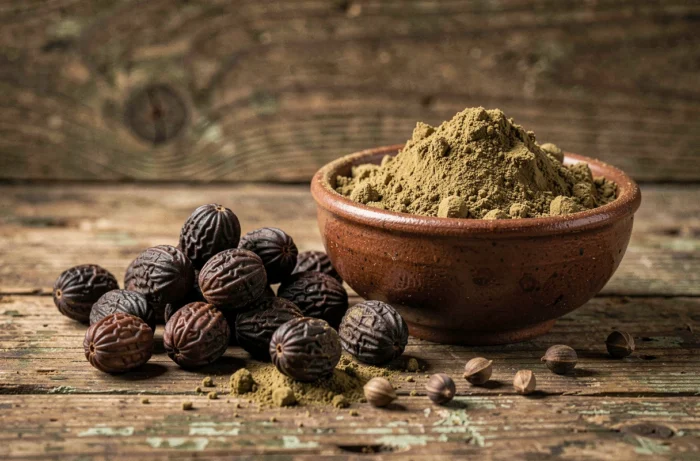
Haritaki (Terminalia chebula) concentrates hydrolysable tannins, phenolic acids, and flavonoids that give it a real pharmacological activity. This activity also involves a profile of side effects that popular literature tends to downplay. We review the concrete risks, documented interactions, and the gray areas that persist around this Ayurvedic drupe.
Contaminants and quality of haritaki powders sold online
The majority of safety incidents related to haritaki do not come from the plant itself, but from the finished product. Powders marketed on marketplaces rarely have a certificate of analysis verified by a third-party laboratory. Without this document, there is no guarantee of the absence of heavy metals (lead, mercury, arsenic) or microbiological contamination.
This problem extends beyond haritaki: it concerns all Ayurvedic plants imported in the form of raw powder. We recommend systematically checking for the presence of a traceable batch and an analytical report before any consumption. Certified organic capsules from a European organization offer a higher level of control than bulk powders, but do not exempt from this verification.
A detailed article lists the dangers and side effects of haritaki, clearly distinguishing what pertains to the fruit itself and what pertains to the quality of the marketed product.

Digestive side effects of Terminalia chebula: dose and frequency
The laxative effect of haritaki is dose-dependent, and this is where the boundary between therapeutic benefit and side effect blurs. At moderate doses, the fruit stimulates transit. Beyond that, it causes diarrhea, abdominal cramps, and dehydration.
The mechanism relies on the concentration of tannins (mainly chebulic acid and gallic acid). These compounds accelerate intestinal peristalsis and alter water absorption in the colon. In a subject already sensitive in the digestive system, even a standard dose can trigger disturbances.
Warning signals to watch for
- Repeated liquid stools in the first hours after intake, indicating a relative overdose or individual sensitivity to tannins
- Persistent abdominal cramps beyond the first day of use, which require immediate cessation
- Rapid weight loss associated with prolonged self-medication, sometimes confused with a “detox” effect when it is actually dehydration
Prolonged daily use without monitoring is the most risky configuration. A cycle of a few weeks followed by a break remains the most cautious practice, in the absence of a standardized clinical protocol.
Drug interactions of haritaki with antidiabetics
Haritaki has documented hypoglycemic activity. This property, often presented as a benefit, becomes a real risk in patients undergoing oral or injectable antidiabetic treatment.
Recent pharmacological databases report a theoretical risk of hypoglycemia when Terminalia chebula is combined with antidiabetics. The mechanism is additive: the plant and the medication lower blood sugar through complementary pathways, which can cause a drop below the safety threshold.
Other interactions to consider
Beyond antidiabetics, the antioxidant and anti-inflammatory properties of haritaki raise questions about its interactions with anticoagulants and immunosuppressants. Data is lacking to quantify this risk, but any co-administration with chronic treatment justifies prior medical advice.
We observe that this warning is almost absent from the product sheets of haritaki-based dietary supplements. Manufacturers limit themselves to the regulatory mention “consult a healthcare professional,” without specifying the concerned drug classes.

Pregnancy, breastfeeding, and haritaki: absence of safety data
No controlled trial establishes the safety of haritaki in pregnant or breastfeeding women. This lack of data does not mean that the plant is dangerous in this context, but it prohibits any recommendation for use.
Traditional Ayurvedic medicine uses haritaki during pregnancy in certain protocols, but these practices are not based on modern toxicological assessments. The precautionary principle fully applies: no intake of haritaki in powder, capsules, or within Triphala during pregnancy and breastfeeding, unless explicitly prescribed by a trained practitioner.
Real risk profile of haritaki: what online reviews omit
Consumer reviews of Terminalia chebula supplements are overwhelmingly positive. This overrepresentation of favorable feedback creates a selection bias: users who have experienced digestive side effects stop taking it without leaving a review, or attribute their symptoms to another cause.
The risk profile of haritaki can be summarized in three axes:
- Direct digestive risk, proportional to the dose and duration of use, ranging from temporary discomfort to severe diarrhea
- Risk of drug interaction, focused on hypoglycemic treatments but potentially extended to anticoagulants
- Risk related to product quality, with possible exposure to heavy metals and contaminants in non-certified powders
Haritaki is not a harmless plant disguised as a dietary supplement. Its pharmacological properties active on transit, blood sugar, and the immune system require the same rigor as any natural health product. Checking product traceability, respecting recommended doses, and informing one’s primary care physician about its use remain the basis for a reasoned use.