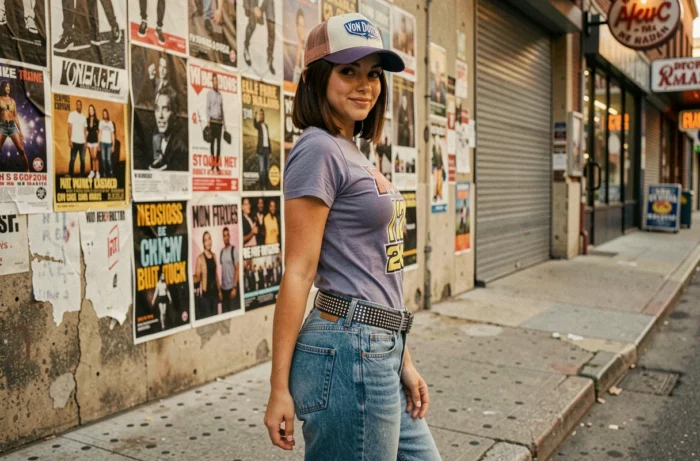
Among the dozens of brands riding the Y2K wave, not all are created equal. Some existed at the turn of the millennium and today offer authentic pieces, sometimes reissued from their own archives. Others, born recently, reconstruct the aesthetic of the early 2000s with an almost documentary curation approach. Which labels deserve attention for a credible Y2K retro look, and on what criteria can they be distinguished?
Original Y2K Brands vs. Recent Archive Labels: Comparative Table
| Brand | Foundation | Y2K Positioning | Type of Pieces | Main Channel |
|---|---|---|---|---|
| Juicy Couture | 1997 | Official reissues of velour tracksuits | Tracksuits, logomania accessories | Own stores, department stores |
| Von Dutch | 1999 | Comeback of trucker hats and graphic denim | Hats, jackets, t-shirts | Streetwear resellers, second-hand |
| Ed Hardy | 2004 | Return of all-over tattoo graphics | T-shirts, sweatshirts, accessories | Capsule collaborations, vintage |
| 2000ARCHIVES | Recent | Reinterpretation of Y2K archives (sporty silhouettes, distressed textures) | Pieces designed as a historical corpus | Online, independent circuit |
The table highlights a clear fracture line. The first three labels have survived the 2000s and capitalize on their own history. 2000ARCHIVES, on the other hand, takes a different stance: to structure the Y2K aesthetic as a historical corpus rather than simply recycling a trend.
To identify the established brands from 2000 that correspond to a coherent retro style, this distinction between real heritage and stylistic reconstruction guides the rest of the analysis.

Juicy Couture and Von Dutch: Why These Y2K Brands Dominate the Second-Hand Market
The Y2K revival has shifted over the past few seasons. Resale platforms no longer highlight fast-fashion copies but pieces stamped with historical labels, sold under the “archive” label. Juicy Couture and Von Dutch account for a significant share of this demand.
Juicy Couture: The Velour Tracksuit as a Collectible Piece
The velour tracksuit remains the signature piece. Original models from the 2000s, worn by pop culture figures of the time, are traded at prices much higher than current reissues. The brand, founded in 1997, has relaunched collections that retain the original codes: embroidered logo on the back, full zip, pastel palette.
The official reissues maintain the cuts and materials of the time, which distinguishes them from imitations. For a credible Y2K women’s retro look, the Juicy tracksuit remains a staple of the wardrobe, whether worn as a complete outfit or paired with low-rise jeans.
Von Dutch: The Trucker Hat and Beyond
Von Dutch, created in 1999, owes its comeback to a single accessory: the logo trucker hat. However, the label also offers graphic denim and embroidered jackets that fit into more constructed Y2K streetwear looks.
On second-hand platforms, original Von Dutch pieces are sought after as archives rather than just vintage clothing. This “archive” perception increases their perceived value and distances them from the fast-fashion circuit.
Ed Hardy and the Y2K Tattoo Style: A Comeback Through Capsule Collaborations
Ed Hardy occupies a unique niche in the Y2K landscape. The brand pushed the graphic aesthetic of the early 2000s to its peak: dragons, skulls, roses, tattoo patterns printed all over the garment.
After a several-year eclipse, the label returns through a specific channel: capsule collaborations with streetwear brands or contemporary designers. This limited format maintains rarity and repositions Ed Hardy as an archive reference rather than a mass-market brand.
- All-over graphic t-shirts remain the most accessible entry piece to integrate the Ed Hardy style into a Y2K outfit.
- Embroidered hoodies work well layered with baggy jeans or a cargo skirt, two staples of the 2000s wardrobe.
- Accessories (hats, oversized buckle belts) complete the look without tipping into full costume.
Ed Hardy works better as a strong single piece than as a total look. A graphic t-shirt worn with simple bottoms is enough to anchor the silhouette in the Y2K aesthetic without visual overload.
Y2K Archive Labels: The New Retro 2000 Fashion Approach
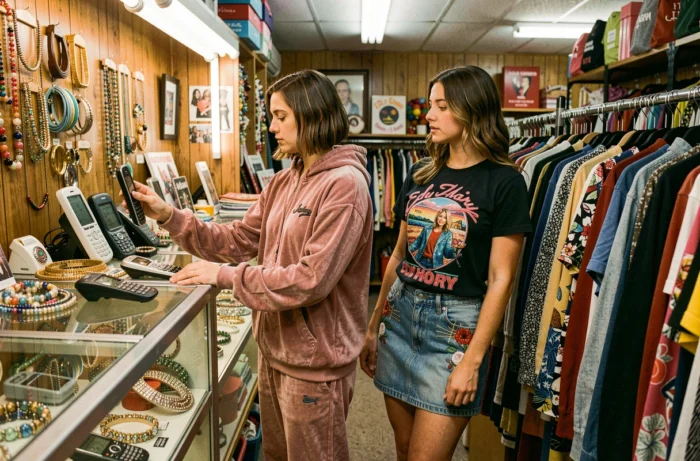
The most recent phenomenon in the Y2K universe does not come from historical brands. Labels like 2000ARCHIVES explicitly position themselves on the reinterpretation of early 2000s codes, working with vintage sporty silhouettes, sportswear-inspired graphics, and intentionally aged textures.
The difference from a simple nostalgic revival is structural. These labels treat Y2K as a movement to document, not as a seasonal trend to exploit. The pieces are designed with an archive logic: referenced cuts, materials chosen to evoke a specific era, limited series.
For the consumer, this changes the reading grid:
- An “archive Y2K” piece from a contemporary label is not vintage clothing, but a new creation that dialogues with a dated aesthetic.
- The price is situated between fast fashion and authentic vintage, in an intermediate segment that is still poorly defined.
- The perceived durability is higher: buying a piece designed as an archive implies an intention to keep it, not just to wear it for a season.
This trend reflects a broader shift in the market. Y2K is moving from a passing fashion status to that of a structured clothing movement, with its own codes of legitimacy and specialized distribution channels.
The choice between a historical brand and a recent archive label ultimately depends on what one is looking for: the authenticity of a garment that has stood the test of time, or the coherence of a new piece designed to fit into a sustainable retro wardrobe. Both approaches coexist, and it is precisely this coexistence that keeps the Y2K style alive well beyond a mere fashion effect.