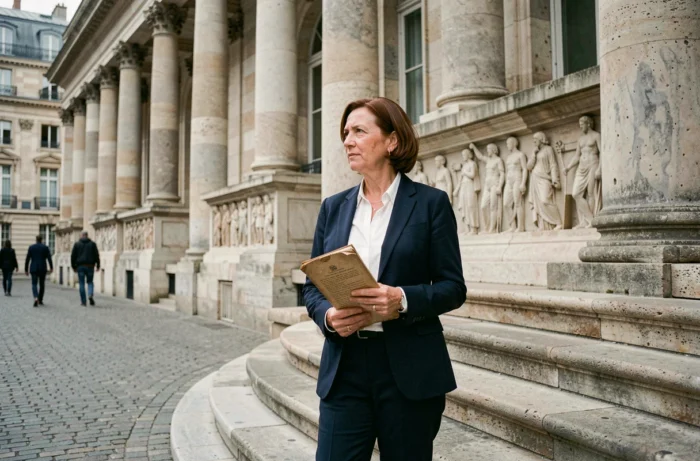
Receiving a fine that one deems unjustified, being denied access to a public service, noticing that a law restricts a daily practice: these situations all raise the same question. What are our fundamental rights, and how can we ensure they are respected when they are threatened? In France, the legal framework that protects fundamental freedoms is based on specific texts, but their concrete application is constantly evolving.
Constitutional Block: the Legal Foundation of Freedoms in France
You may have noticed that political debates often invoke “the Constitution” without specifying which text is being referred to? The term actually encompasses several documents. The Constitution of October 4, 1958, directly enshrines few rights. It establishes the principle of equality before the law without distinction of origin or religion, and the principle of secularism.
Most concrete freedoms come from elsewhere: the Declaration of the Rights of Man and of the Citizen of 1789, the preamble of the Constitution of 1946, the Charter for the Environment of 2004. Together, these texts form what legal experts call the constitutional block. It is this block that the Constitutional Council uses to verify that a law respects our freedoms.
At the European level, the European Convention on Human Rights adds an additional layer of protection. A citizen who believes that France has violated their rights can bring a case before the European Court of Human Rights after exhausting national remedies. Resources like noslibertes.org help make this system more understandable to the general public.

Constitutional Censorship of Social Media: A Concrete Case of Protection of Freedoms
Legal texts seem abstract until we see their effects. A recent example illustrates the mechanism well. Parliament voted on a law prohibiting access to social media for those under 15, with an expected implementation date in the fall of 2026.
The Constitutional Council censored the central article of this law on August 14, 2026. Its reasoning: the blanket ban was disproportionate in light of freedom of expression and respect for privacy. In other words, protecting minors is a legitimate goal, but the chosen means excessively infringed upon a fundamental right.
This was not the first attempt. A law from 2023 had already established a “digital majority” at 15 years, but the implementing decree was never published. Result: two laws passed, zero effective application. This sequence shows that passing a law is not enough to change the actual rights of citizens. Constitutional control and the requirement for an implementing decree are concrete filters.
Three Fundamental Rights Tested Daily
Rather than listing them all, let’s focus on three freedoms whose practical scope is regularly debated.
Freedom of Expression and Its Limits
Freedom of expression does not mean “saying anything without consequence.” It is framed by specific offenses: defamation, insult, incitement to hatred. The balance between protected expression and punishable speech shifts depending on the context, and it is the judge who decides on a case-by-case basis.
Right to Respect for Privacy
The protection of personal data extends this right into the digital space. The CNIL monitors compliance with the GDPR and can sanction companies that collect information without a legal basis. However, privacy also comes into tension with public safety, for example, when surveillance systems are deployed in public spaces.
Freedom of Movement
This freedom seems established. It becomes visible when it is restricted: curfews, states of emergency, exclusion zones during demonstrations. Each restriction must be limited in time and proportional to the threat, under penalty of annulment by the administrative judge.
- Freedom of expression protects opinions, but not calls for violence or defamation.
- The right to privacy also covers digital data, monitored by the CNIL.
- Freedom of movement can be temporarily restricted, but any measure must remain proportionate.

Legal Remedies to Defend Fundamental Rights in France
Knowing your rights is useless if you don’t know how to assert them. Several avenues for recourse exist, each suited to a different situation.
The emergency freedom procedure before the administrative court allows for a decision to be obtained within 48 hours when an administration seriously infringes upon a fundamental freedom. It is the fastest tool in the French system.
The Priority Question of Constitutionality (QPC) gives any litigant the opportunity to challenge the conformity of a law to the constitutional block, directly during a trial.
- The emergency freedom procedure: referral to the administrative judge for serious and manifestly illegal infringement of a fundamental freedom.
- The QPC: challenge to the constitutionality of a law before the Constitutional Council, accessible to any citizen during a trial.
- Referral to the European Court of Human Rights: ultimate recourse after exhausting internal avenues, if France has violated the Convention.
- The Defender of Rights: an independent authority that handles complaints without judicial proceedings, particularly in cases of discrimination.
The Council of State also plays a watchdog role. The principle of proportionality appears as a common thread in each recourse: a restriction of freedom is legal only if it is necessary, appropriate, and not excessive.
The defense of fundamental rights in France does not rely on a single text or institution. It operates through an accumulation of guarantees, from the constitutional block to European recourse, through the daily oversight of the administrative judge. Each citizen has concrete tools to contest an infringement of their freedoms, provided they know which to activate at the right moment.