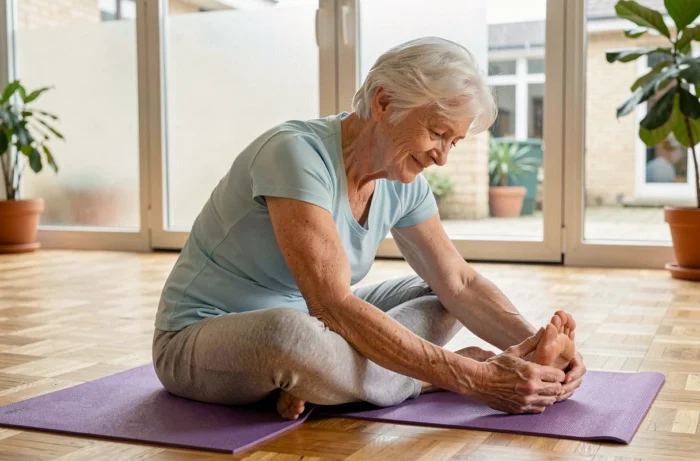
Getting up from a chair, reaching for an object on a high shelf, walking to the mailbox: after 80 years, these everyday actions require muscular and joint capabilities that the body gradually loses without regular activity. Gentle exercise helps maintain these abilities, provided the practice is adapted to a body that no longer responds as it did at 60 or 70 years old.
Breaking up the effort: the logic of cumulative volume after 80
Most gentle exercise programs for seniors offer sessions of 20 to 30 minutes. For an unconditioned 80-year-old, this format can be discouraging or cause excessive fatigue. The WHO recommendations (2020), reiterated in recent physical activity guides, emphasize a different principle: any volume of moderate activity, even broken into blocks of 5 to 10 minutes, provides measurable benefits.
Specifically, getting up from a chair three to five times, walking in the hallway for a few minutes, then doing some arm movements already constitutes a useful dose. Repeated two or three times throughout the day, this accumulation is as valuable as a continuous session for autonomy and fall prevention. If you find gentle exercise for 80-year-olds on Seniors des Infos, you will notice that this progressive approach is also favored there.
The goal is not to meet a time quota, but to create short and frequent habits that the body tolerates without pain or exhaustion.
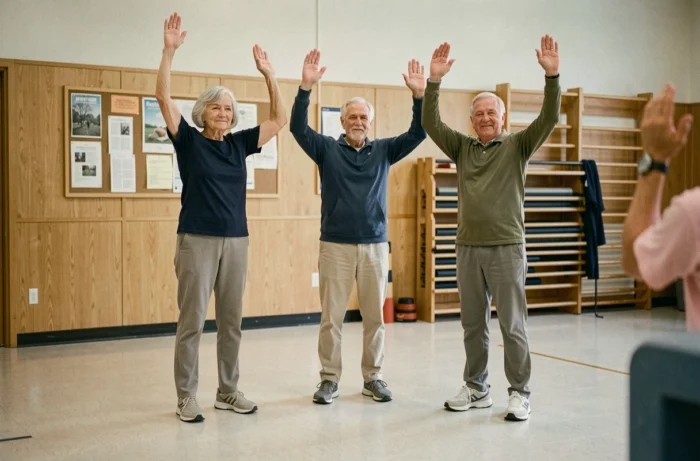
Three functional movements that protect autonomy
Why talk about “functional” movements? Because they replicate actions you perform every day. Practicing these movements as exercises makes them safer in daily life.
Chair rise without hands
Sit at the edge of a stable chair, feet flat and hip-width apart. Cross your arms over your chest. Lean your torso slightly forward, then push through your heels to stand up. Sit back down slowly, controlling the descent.
This exercise strengthens the quadriceps and glutes, the two muscle groups most engaged in getting up from a chair or the toilet. Start with three repetitions. If the movement is too difficult without hands, place your palms on your thighs for assistance, then gradually reduce the support.
Side arm raise with support
Stand facing the back of a chair, both hands resting on it, raise one arm to the side until shoulder height. Hold for two seconds, then lower it. Alternate with the other arm.
This movement works the shoulders and trunk stabilizing muscles. It prepares the action of reaching for an object in a cupboard or dressing without assistance. Keeping one hand on the chair secures balance throughout the exercise.
Heel-to-toe walk along a wall
Stand sideways along a wall, one hand resting on it for stability. Move forward by placing the heel of one foot just in front of the toes of the other, as if on an imaginary line. Take five to eight steps, then return.
This exercise engages balance sensors and ankle muscles. The proximity of the wall replaces a partner and allows for safe solo practice.
Adapting gentle exercise to common physical constraints after 80
Osteoarthritis, hip prosthesis, shortness of breath, bone fragility: at this age, potential contraindications are numerous. Adaptation does not mean eliminating exercise, but modifying its range and speed.
- In the case of knee osteoarthritis, the chair rise is done on a higher seat (a thick cushion on the chair), which reduces the angle of flexion and joint pressure.
- After a hip prosthesis, internal rotation movements should be avoided. The side arm raise remains entirely possible, and the heel-to-toe walk can be practiced without strain on the hip.
- In case of positional dizziness, seated exercises should be prioritized initially. Position changes (sitting to standing) should be done slowly, with a pause of a few seconds in between.
A medical opinion before starting remains a useful precaution, especially with heart problems. The primary care physician or a physical therapist can guide towards adapted physical activity (APA) supervised by a trained professional.
Consistency over six months: the true marker of results
You may have noticed that after a week of bed rest, getting up becomes more difficult? Muscle loss is rapid in octogenarians, but the good news is that recovery is possible at any age with regular practice.
Recent research shows that the benefits of physical exercise in very elderly seniors only fully manifest after several months of continuous practice, with at least two sessions per week. The first weeks improve confidence and fluidity of movements. Measurable gains in balance and strength appear later.
To maintain consistency over time, two principles help:
- Associate exercises with a fixed time of day (after morning coffee, before the news) to anchor the habit.
- Vary the movements from one session to another, even slightly, to avoid boredom. Alternating the chair rise with a balance exercise or some back stretches is sufficient.
- Note the sessions on a calendar. Seeing the checked days boosts motivation, especially during weeks when enthusiasm is lacking.
Consistency matters more than intensity. Five minutes every day is better than an hour once a week. After 80, gentle exercise does not need to be spectacular to be effective. It needs to be consistent.