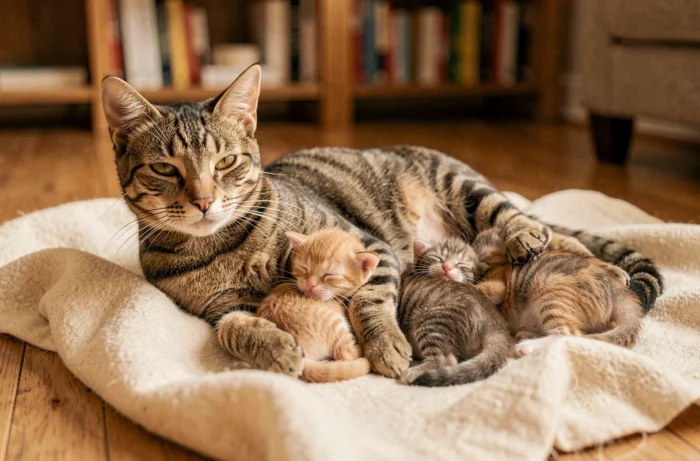
A kitten found under a hedge, a litter to place after an unexpected birth, a breeder offering a departure at six weeks because the mother “doesn’t want them anymore”: in each of these cases, the question of the right time to separate a kitten from its mother arises very concretely. The answer lies in a few biological and legal markers, but their application in practice requires a bit more discernment than just a simple number.
Physical signs that show a kitten is not ready
Before discussing age, it’s beneficial to observe the behavior of the litter. A kitten that is still actively nursing several times a day, shows no interest in its mother’s food bowl, and consistently sleeps close to her has not begun its weaning process. At this stage, removing it would be akin to cutting off its only source of nutrition and thermal regulation.
Nutritional weaning generally begins around three weeks, when the first teeth emerge. The mother then pushes her kittens away during nursing because sucking becomes painful for her nipples. This is the natural signal that encourages kittens towards solid food.
Softened kibble or wet food can be offered from this point. If a kitten is eating independently, drinking water, and using the litter box, the weaning process is on the right track. But this is only part of the process.
Understanding optimal kitten weaning involves distinguishing this nutritional independence from emotional and behavioral weaning, which takes several more weeks.
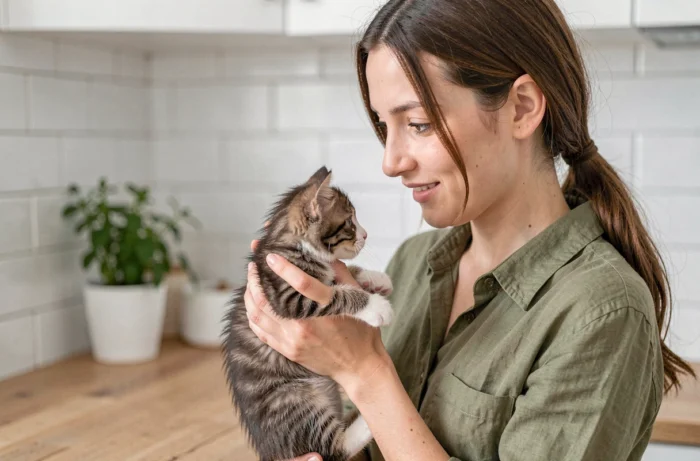
Behavioral weaning of the kitten: what happens between 8 and 12 weeks
Most online competitors stop at the nutritional question. However, in practice, it is the socialization period that poses the most problems when it is shortened.
Learning bite inhibition
Between the sixth and twelfth week, the mother corrects kittens that bite too hard. She hisses, gives a measured swat, and moves away. This mechanism teaches the kitten the boundary between play and aggression. A kitten separated before it has understood this signal will tend to bite hard while playing, a behavior that the future adopter will take months to correct.
Managing frustration
The mother gradually refuses nursing, pushes away kittens that constantly solicit her, and forces them to stay away for longer periods. It is through this process that the kitten learns to tolerate frustration and absence. Without this step, we often observe kittens that develop separation anxiety in their new home: nighttime meowing, destruction, and uncleanliness.
Reports vary on this point depending on the litters, but the trend is clear: a kitten removed at eight weeks adapts less well than a kitten that stays until twelve weeks.
Legal framework in France: 8 weeks minimum, increased penalties
Article L.214-8 of the Rural Code imposes a minimum age of eight weeks for transferring a kitten, whether by sale or donation. This threshold corresponds to the strict legal minimum, not to a suitable veterinary recommendation.
Since January 1, 2024, the sale of cats in pet shops is prohibited. A decree published in the summer of 2026 has increased penalties: any transfer in a pet shop is subject to a fine of up to 1,500 euros per animal, and up to 3,000 euros in case of repeat offenses.
In practice, this ban redirects adopters to breeders, shelters, and individuals. The adoption timeline changes: one no longer impulsively goes to a pet shop. One contacts a breeder, visits the litter, and waits for the kittens to reach the required age. This longer process promotes a better-prepared separation.
- No kitten can legally leave its mother before 8 weeks, regardless of the transfer channel.
- Serious breeders and associations generally wait 10 to 12 weeks before entrusting a kitten.
- The veterinary certificate provided during the transfer must attest that the kitten is weaned and healthy.
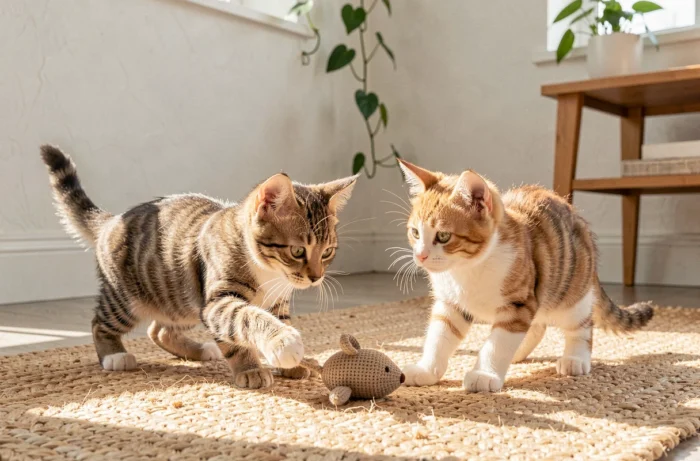
Special cases: orphaned kittens or those from stray cats
Litters from stray cats represent a common situation where the question of separation arises differently. The mother is sometimes unapproachable, injured, or has disappeared. In these cases, the kitten arrives with humans well before the ideal weaning age.
Emergency feeding
A kitten under three weeks cannot survive without maternal milk or kitten milk replacer. Cow’s milk is unsuitable: its composition causes diarrhea that can be fatal at this age. Specific milk replacers can be found at the veterinarian or in specialized pet shops. Bottles should be given every two to three hours for newborns.
Replacement socialization
Without a mother, the kitten does not benefit from the behavioral corrections described above. One can partially compensate by introducing it to other balanced adult cats, or at a minimum with other kittens from the litter. A kitten raised alone, without feline contact, has an increased risk of behavioral problems in adulthood.
- Keep siblings together as long as possible, even in the absence of the mother.
- Consult a veterinarian as soon as care begins to check the health status and estimate the kitten’s age.
- Handle the kitten daily to get it used to human contact, without completely replacing interaction with other cats.
The twelve-week rule remains the most reliable benchmark for a separation under good conditions. When the mother is present and healthy, each additional week spent with her strengthens the kitten’s future balance. For orphaned kittens, the priority shifts to appropriate feeding and maintaining the sibling group, two concrete levers that limit the damage of a separation that occurs too early.