Choosing scanning software for important documents is no longer just about comparing basic scanning functions. The European regulation eIDAS 2 (EU 2024/1183), adopted in 2024, extends the scope of trust services to qualified electronic archiving. This regulatory evolution changes the selection criteria: the software must now fit into a complete chain of evidence, not just produce a readable file.
eIDAS 2 Compliance and Qualified Archiving: The Criterion That Comparisons Overlook
Most selection guides evaluate scanning software based on its speed, optical character recognition (OCR), and export formats. These criteria remain valid, but they are no longer sufficient for documents with probative value: contracts, accounting documents, HR files.
With eIDAS 2, qualified electronic archiving becomes a trust service recognized at the European level. Therefore, efficient scanning software must be able to integrate with a qualified archiving provider or at least produce formats and metadata compatible with these requirements. Checking this integration capability before purchase avoids having to change tools a few months later.
For organizations that handle binding documents, the choice of efficient scanning software hinges on this preliminary question: can the scanned file be submitted to a compliant archiving system without additional manipulation?
OCR, IDP, and Intelligent Processing: Comparative Table of Scanning Approaches
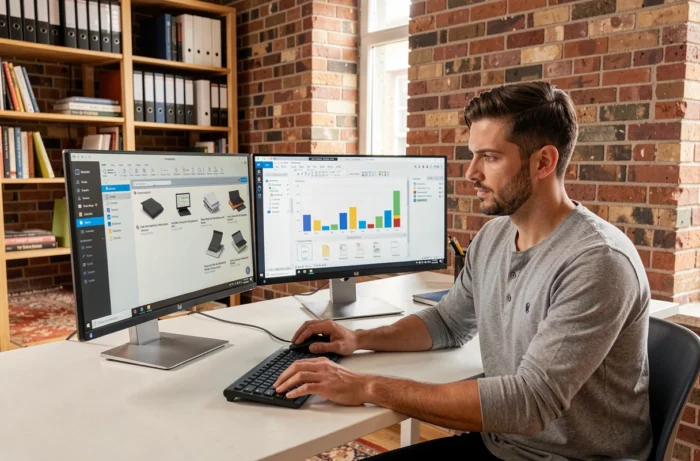
A 2025 AIIM study indicates that 66% of new IDP projects replace an existing solution, deemed insufficient in the face of volumes and diversity of formats. This massive shift towards intelligent document processing (IDP) is reshaping the categories of available software.
| Criterion | Classic Scanner/OCR | IDP Platform |
|---|---|---|
| Text Recognition | Standard OCR, printed text | Advanced OCR + AI, including handwriting |
| Automatic Classification | Manual or by folder | Automatic by document type |
| Structured Data Extraction | Limited to predefined fields | Contextual extraction (invoices, contracts, forms) |
| Qualified Archiving Integration | Rare, simple PDF export | GED connectors and trust services |
| Volume Management | Suitable for low volumes | Batch processing, scalable |
| Entry Cost | Low or free | Subscription, often by processed volume |
For personal or occasional use (a few documents per week), a classic OCR tool remains sufficient. However, as the volume increases or the documents have legal value, an IDP platform significantly reduces classification and data entry errors.
Technical Criteria for Evaluating Document Scanning Software
Beyond the OCR or IDP positioning, several technical parameters determine the actual quality of scanning. Neglecting them leads to unusable files or time losses in reprocessing.
- Quality of Multilingual OCR Recognition: A good OCR engine must handle accented characters, nested tables, and documents in multiple languages without manual configuration on each page.
- Export Formats and Metadata: The software must produce at least PDF/A (long-term archiving format) and allow the addition of metadata (date, document type, author) directly during scanning.
- Hardware Compatibility: Some software only works with scanners of the same brand. Checking TWAIN or WIA compatibility ensures freedom of hardware choice.
- Processing Security: For sensitive documents, processing must remain local or pass through servers compliant with GDPR. Some mobile applications send images to non-EU servers without clear warning.
The PDF/A format deserves special attention. A document scanned in JPEG or standard PDF may have its metadata altered during transfer. PDF/A locks the content and metadata in a durable format, which is a prerequisite for any serious archiving.
The Trap of Uncontrolled Cloud Processing
Several free or freemium tools offer efficient OCR but process documents on remote servers. For a vacation photo, this poses no problem. For a signed contract or a payslip, the location of processing becomes critical.
Before validating a tool, always check if the OCR processing occurs locally, on a European cloud, or on infrastructures located outside the European Union. This information is rarely found on the software’s homepage but appears in the terms of use or privacy policy.
Mobile Scanning or Fixed Station: What Use for Which Documents
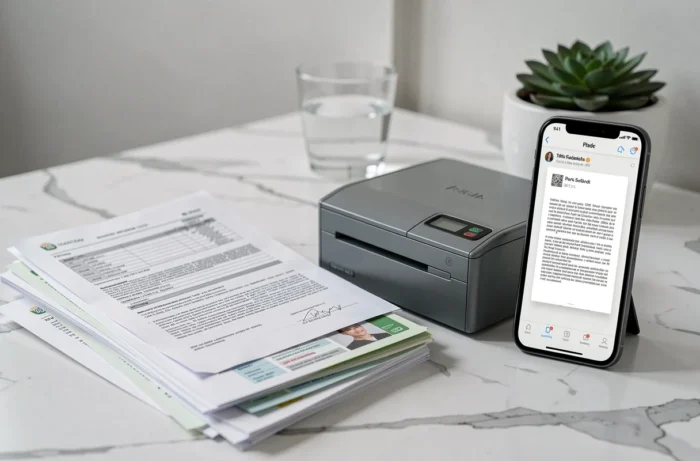
Mobile applications (Adobe Scan, Microsoft Lens, CamScanner) have made significant progress. Their built-in OCR rivals some desktop software for simple documents: receipts, business cards, short handwritten notes.
However, for multi-page documents with complex formatting (tables, columns, small print), a dedicated scanner coupled with desktop software remains more reliable. The sensor resolution of a smartphone, even a recent one, introduces optical distortions that the software imperfectly corrects in the peripheral areas of the page.
The choice therefore directly depends on the type of documents being processed:
- Common documents with low legal stakes: a mobile application is sufficient, provided the data processing location is verified.
- Contractual, accounting, or regulatory documents: desktop software with PDF/A export and a connector to a qualified archiving system provides security that mobile applications do not yet guarantee.
- Large volumes (more than a few dozen pages per day): an IDP software with batch processing avoids bottlenecks.
The decisive criterion for important documents is ultimately not the brand of the software or the number of displayed features. It is the tool’s ability to produce a compliant, traceable, and archivable file from the very first scan, without any conversion or additional reprocessing steps. Software that requires exporting, converting, and then reimporting to obtain a usable format adds risk with each manipulation.