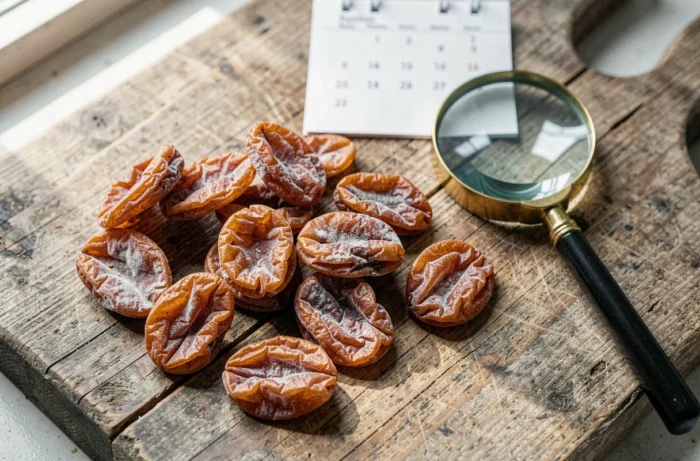
A forgotten bag of prunes at the back of the cupboard, with a date that has passed for several months: the temptation to throw them away is strong, but so is the temptation to taste them. Prunes are dried fruits with low water content, which gives them a much longer shelf life than most fresh foods. However, the question deserves to be asked, as the date on the packaging doesn’t tell the whole story.
Mycotoxins and Salmonella: Invisible Risks in Dried Fruits
Most online advice focuses on visible mold. If the prune is not moldy, it would be consumable. This reasoning overlooks a well-documented danger highlighted by French health authorities in recent years.
Recalls of batches of dried fruits have been triggered due to contamination with ochratoxin A, a mycotoxin produced by certain molds. The disturbing point: these products sometimes had a still-distant best before date and showed no visual defects. In other words, a dried fruit can contain mycotoxins without appearing altered.
Cases of Salmonella presence in batches of dried fruits have also been reported recently, with official instructions for product destruction. The low water activity in prunes does not always prevent bacterial contamination that occurred upstream, during drying or packaging.
These situations remain rare for a consumer shopping at a supermarket. However, they remind us that the absence of visible mold does not guarantee the safety of a prune, whether expired or not. The real risk factor is more related to production and storage conditions than to the date on the package alone.
Best Before Date and Use By Date on Prunes: Two Dates, Two Logics
Have you noticed the different mentions on your packaging? Prunes almost always carry a best before date (BBD), recognizable by the phrase “best before.” This date has nothing to do with a use by date (UBD).
The BBD indicates until when the manufacturer guarantees the product’s appropriate taste and nutritional qualities. Once surpassed, the prune may lose its softness, aroma, or color, without becoming dangerous. The UBD, on the other hand, concerns perishable goods (meat, yogurt, fresh fish) and indicates a real health risk beyond the date.
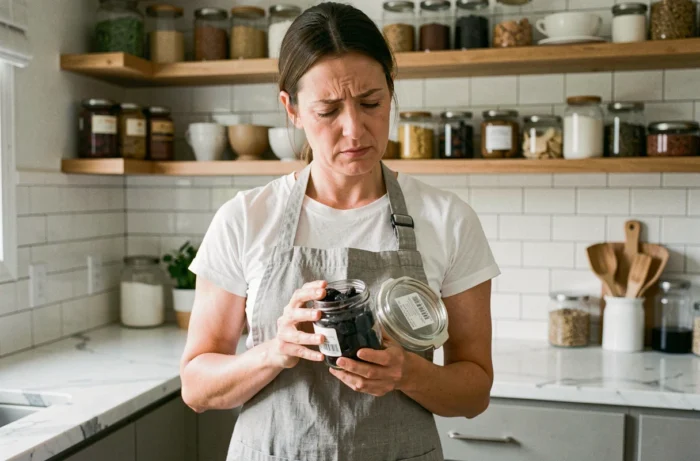
To find out if we can safely eat expired prunes, you first need to check which date it is. A prune whose BBD has been exceeded by a few months, stored under good conditions, is generally still consumable. A product with an exceeded UBD, however, should be discarded without hesitation.
Concrete Signs of a Spoiled Prune
Once past the BBD, prunes evolve slowly. A few sensory indicators can help you decide before tasting.
- Texture: a prune that has become as hard as a marble has lost too much moisture. It is not necessarily dangerous, but its taste interest is low. Conversely, an abnormally sticky or moist prune in a bag that has been open for a long time should raise alarms.
- Smell: a sour, fermented, or chemical smell (reminiscent of vinegar) indicates advanced degradation. A healthy prune smells like a dried fruit, slightly sweet.
- Appearance: white crystals on the surface are often sugar that has migrated, not mold. However, green or black spots or a fuzzy film require discarding the entire batch, not just the affected prunes.
- Taste: if you pass the first three tests, taste a small piece. A rancid or bitter taste means that the lipids have oxidized, and the entire batch should be discarded.
Storing Prunes: Mistakes That Accelerate Degradation
The actual shelf life of a prune depends less on the printed date than on what happened between purchase and opening the package. Two mistakes are commonly made.
The first: leaving the bag open in a cupboard. Prunes absorb ambient moisture, which promotes microbial development. A sealed container is the first conservation reflex. A glass jar with a seal, a well-sealed zip bag, or a vacuum-sealed box significantly extend the usable life.
The second: storing prunes near a heat source (oven, stove, exposed window). A stable, cool temperature away from light is much better. The refrigerator also works, provided you keep a sealed container to prevent the prunes from absorbing surrounding odors.
Can We Freeze Prunes to Extend Their Shelf Life?
Freezing works, and it’s even an underestimated solution. Prunes handle freezing well due to their low water content. They thaw in a few minutes at room temperature and regain a texture very close to the original.
Freezing an opened bag before the BBD allows you to have prunes that can be used several months later, without significant loss of taste or nutritional value.
Expired Prunes in Cooking: Transform Rather Than Toss
A prune whose BBD has passed but passes visual and olfactory tests remains perfectly usable in cooking. Its slight drying can even become an asset.
Rehydrate the prunes in hot tea, orange juice, or an alcohol of your choice for about twenty minutes. They regain their softness and absorb the flavors of the liquid. This technique works for compotes, tagines, or fruit cakes.
Very dry prunes can be blended into powder and replace part of the sugar in pastries. Prune pulp adds binding, moisture, and a caramelized flavor that reduces the need to add refined sugar.
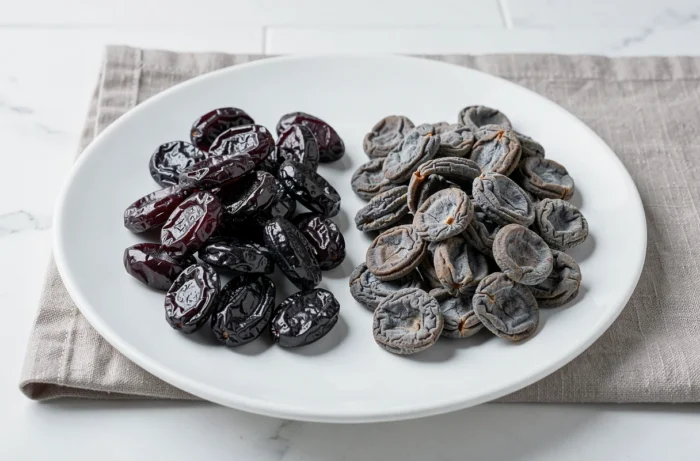
An expired prune is not an automatic waste. The surpassed BBD indicates a decrease in quality, not an immediate danger. The real health risks, mycotoxins or bacterial contaminations, are not visible to the eye and concern production defects much more than the mere passage of time in your cupboard. Check the texture, smell, and taste, store properly, and trust your senses as much as the date on the label.